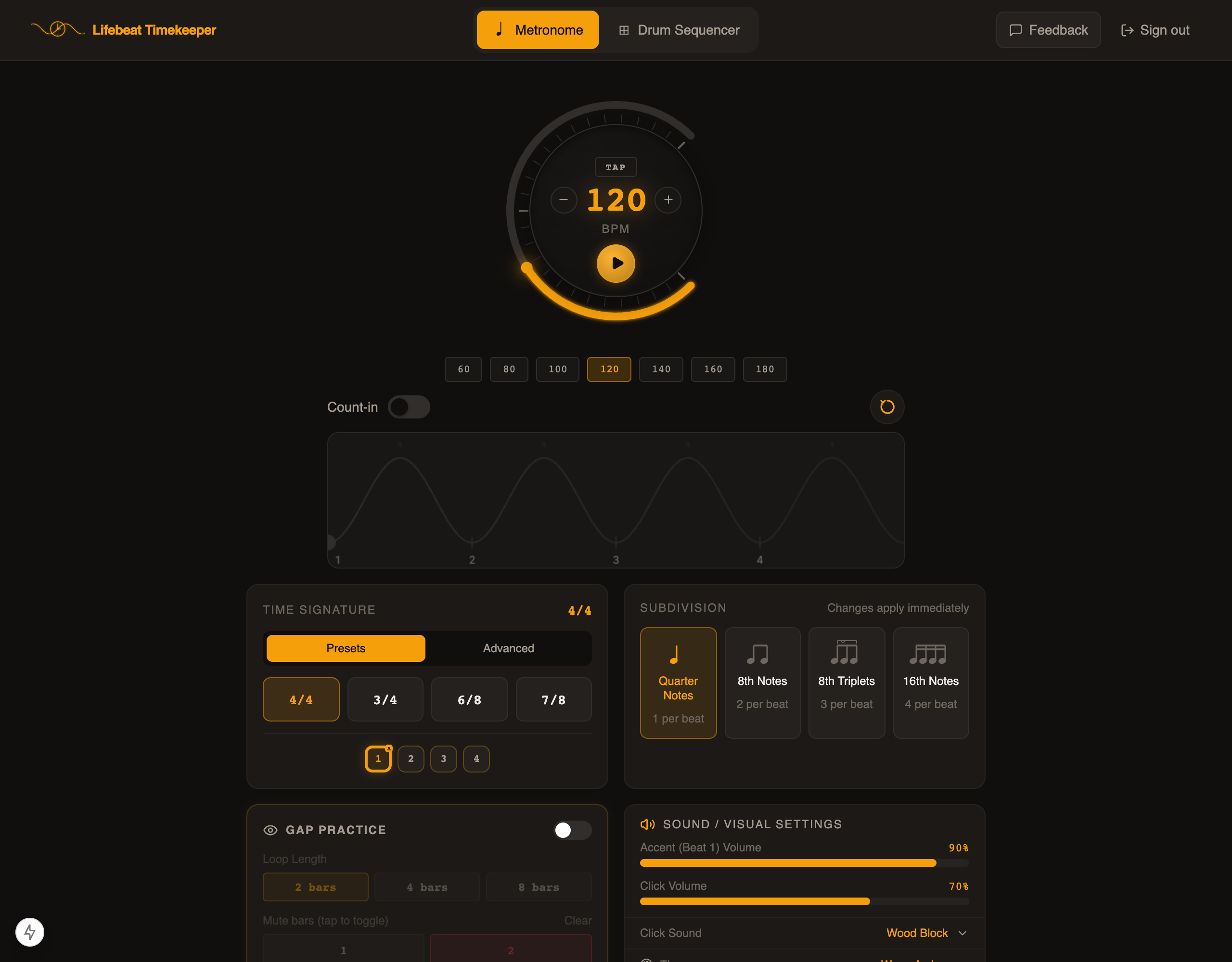
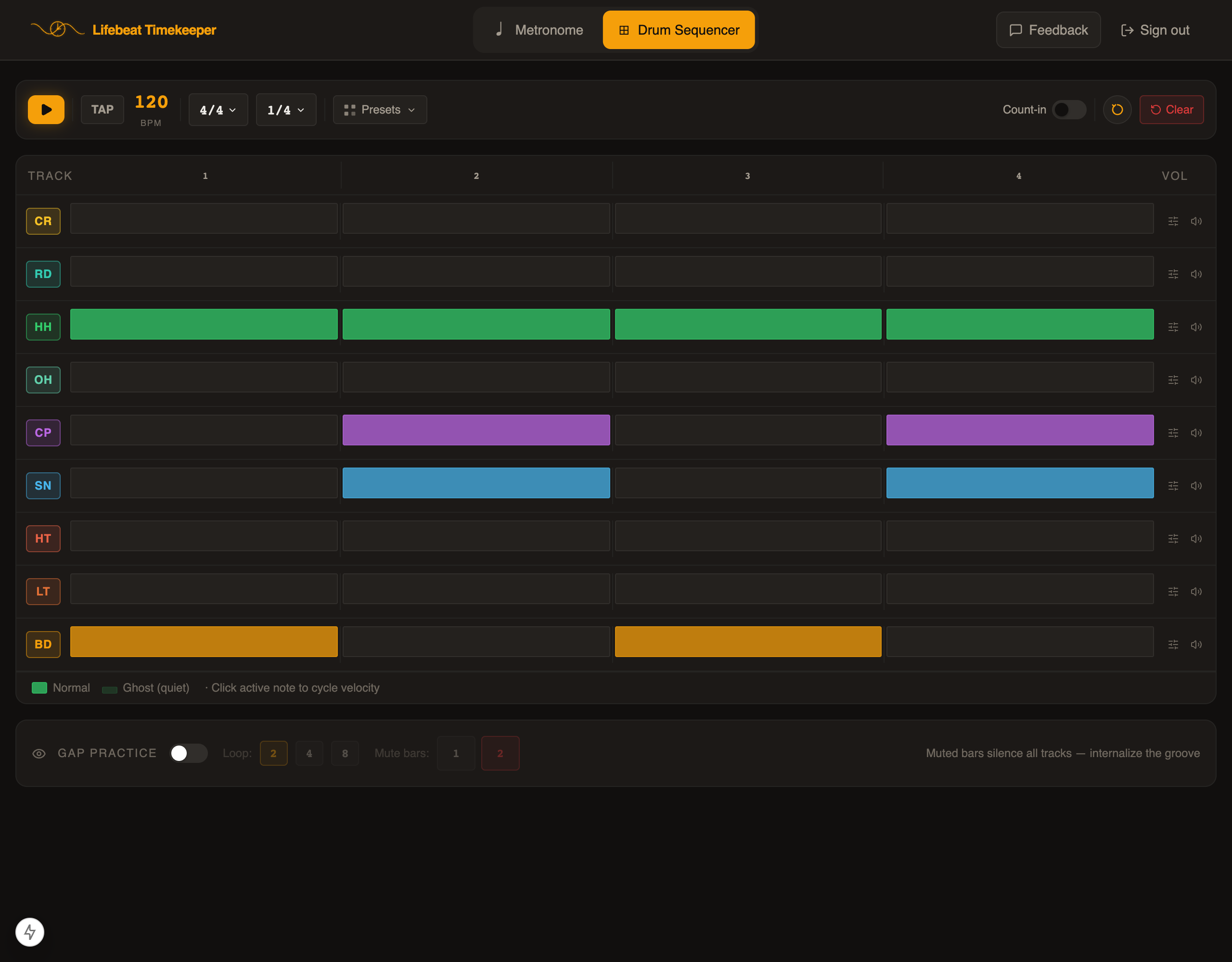
The app has a name of its own. Everything you have made comes with it, and the old address keeps working and sends you on, so nothing you have saved or bookmarked is lost.
Your account, your presets, your routines, your subscription and your practice record all come with you. None of them were ever stored in the address.
The old address keeps working. It sends you to the new one, so a link you saved a year ago still opens the right thing.
You are signed back in once, and the drum sounds download once more the first time you play. Both are one-off, and they happen because a browser keeps those per address.
If Timekeeper lives on your home screen, open timekeeper.life once and add it to your home screen again. The old icon still opens the app, but it is the old address wearing the icon, so it will keep asking you to sign in.
A peek inside a bar
September 4, 2026
Beats
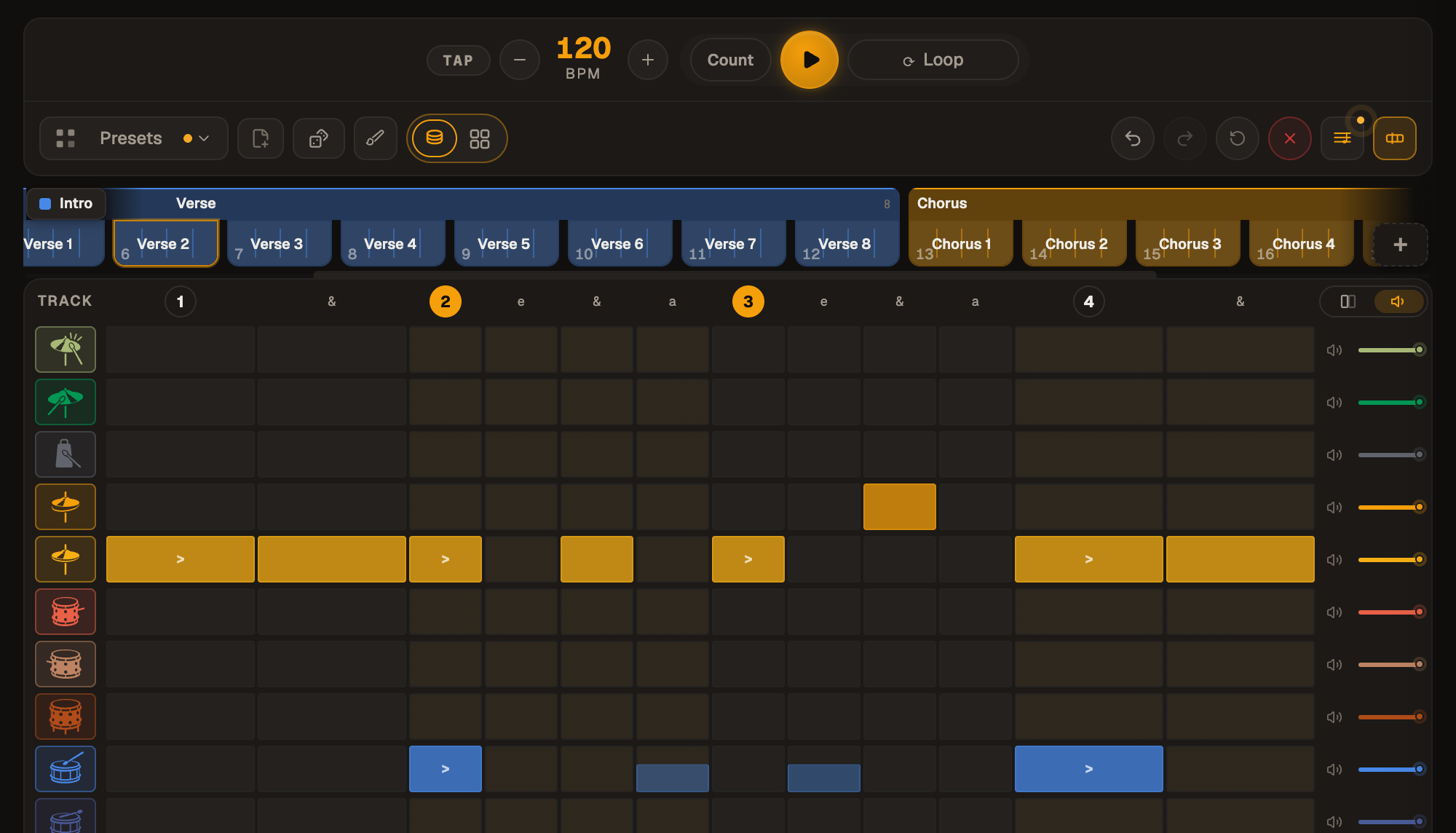
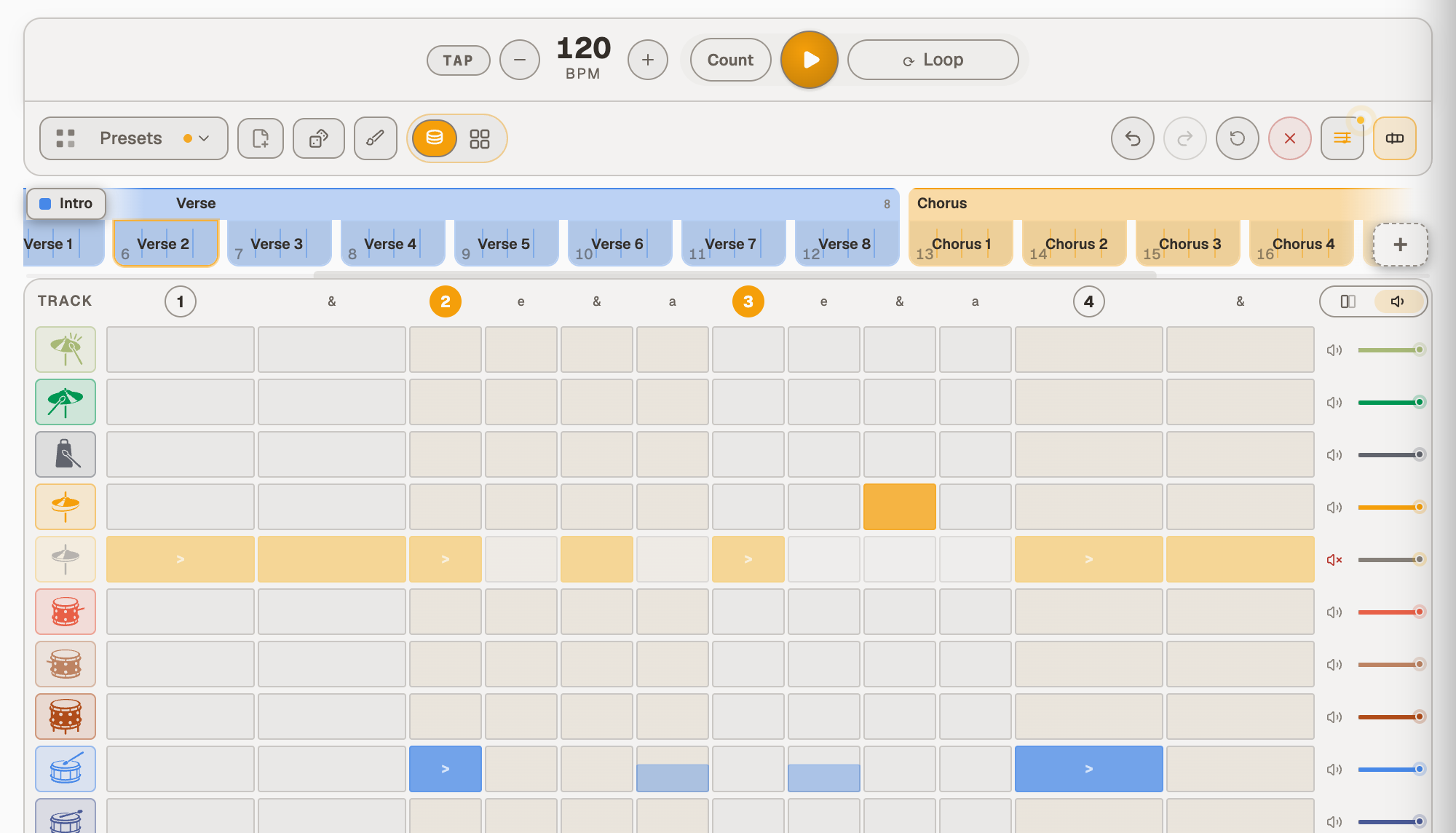
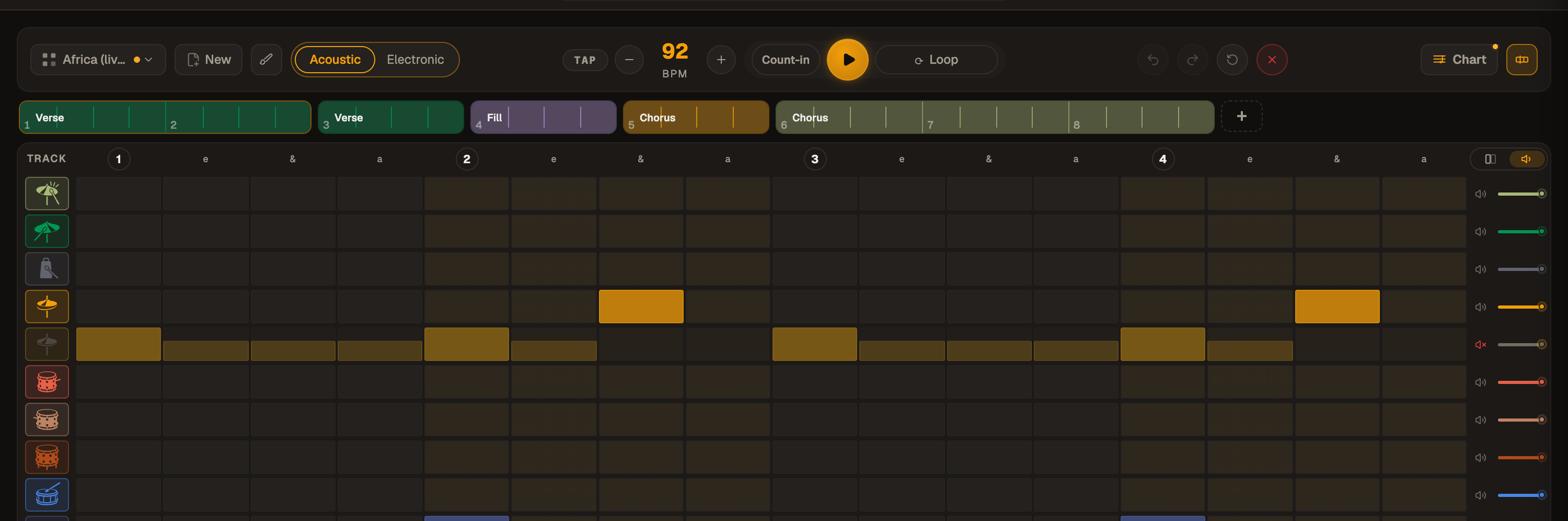
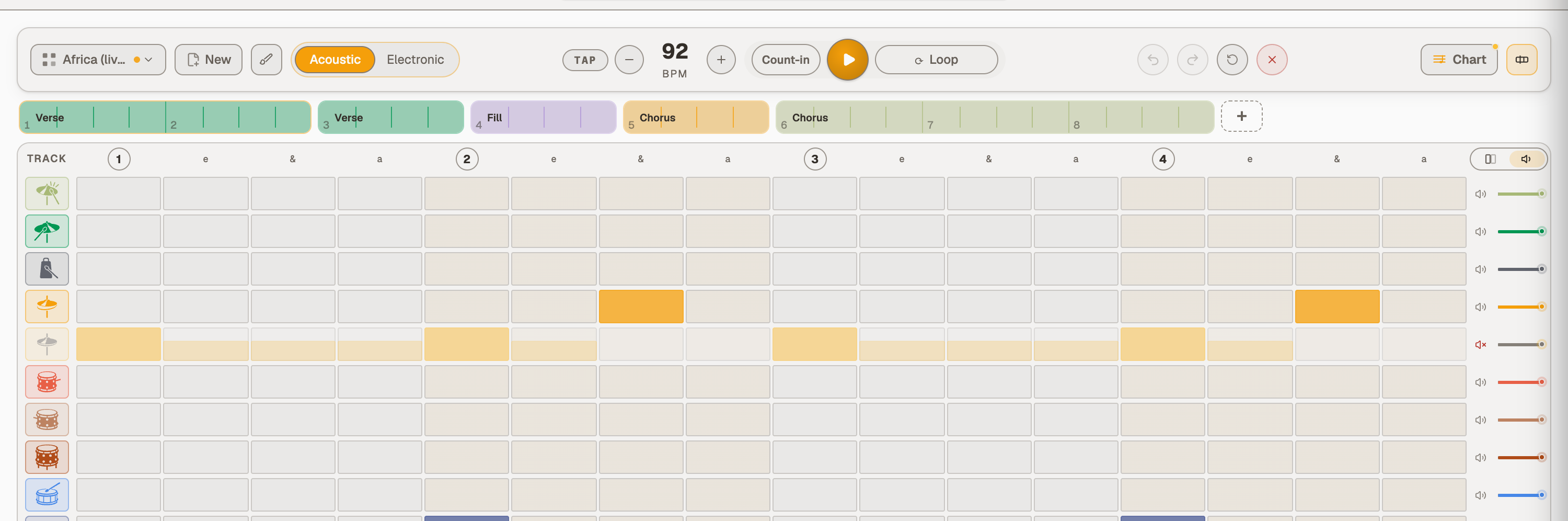
Rest the mouse on a bar in the song strip and a small copy of its grid drops down beneath it, so you can tell three fills apart without leaving the one you are working on.
Every hit, ghost and accent sits where the editor draws it: the preview is the grid, shrunk, not a summary of it.
Move along the strip and it follows instantly, so comparing bars is three glances instead of three trips into the editor.
Nothing opens and nothing changes. The editor stays on the bar you were working on.
It answers a mouse, so it is a desktop thing. Hold or right-click the strip button in the transport for Bar previews and Section names.
Bar 2 of Jazz, without opening it: the ride and its skip notes, the ghosts the snare is comping with, the kick feathered underneath.
A map under the song
September 4, 2026
Beats
Writing a full song in Beats earned the song strip a round of upgrades. The headline: the thin bar under it is now a map, every section's colour in order, and the part on screen is lit.
Tap anywhere on the map and the strip glides there. The lit stretch is always where you are.
Tap a section name and the editor opens its first bar.
With bars selected, the plus menu drops its copies right after them instead of at the end of the song.
Hold or right-click the strip to hide section names; the same gesture brings them back.
Press R to rename what is selected, Cmd G (Ctrl G on Windows) to group it into a section.
Longer names, room for 192 bars, and dragging a bar past the edge scrolls the strip along with you.
The whole song in one line under the bars: dim where you are not, lit where you are.
Song sections
September 2, 2026
Beats
The song strip can name its parts now. Group bars into sections, Intro, Verse, Chorus, and a slim band above the bars carries each name and colour, so a long song reads like a song instead of a row of bars.
Select bars and press Make a section: the name is guessed from where it sits and ready to type over.
A quick double tap on the band opens its card: rename, recolour, duplicate, fold, loop or ungroup.
Colour the bars to match paints every bar in the section with its colour, one step, one undo.
Bars dragged into the middle of a section join it; bars dragged out leave it; a bar dropped on the band itself files at that end.
Duplicate copies the whole section straight after itself as a second section with the same name, and the plus menu at the end of the strip offers a copy of any section.
Fold a section to a single cell to see the whole song at a glance: the count stays, the music never changes, and a tap unfolds it.
Loop this section puts the practice loop on exactly those bars.
When a section is off screen, a small chip waits at that edge of the strip: tap it and the song walks there, section by section.
Hide section names gives the height back and keeps a thin colour line over each section as a landmark.
One song, its sections named and coloured, and a chip at the edge for the part scrolled away.
Pattern comes to every account
August 28, 2026
Inner Pulse
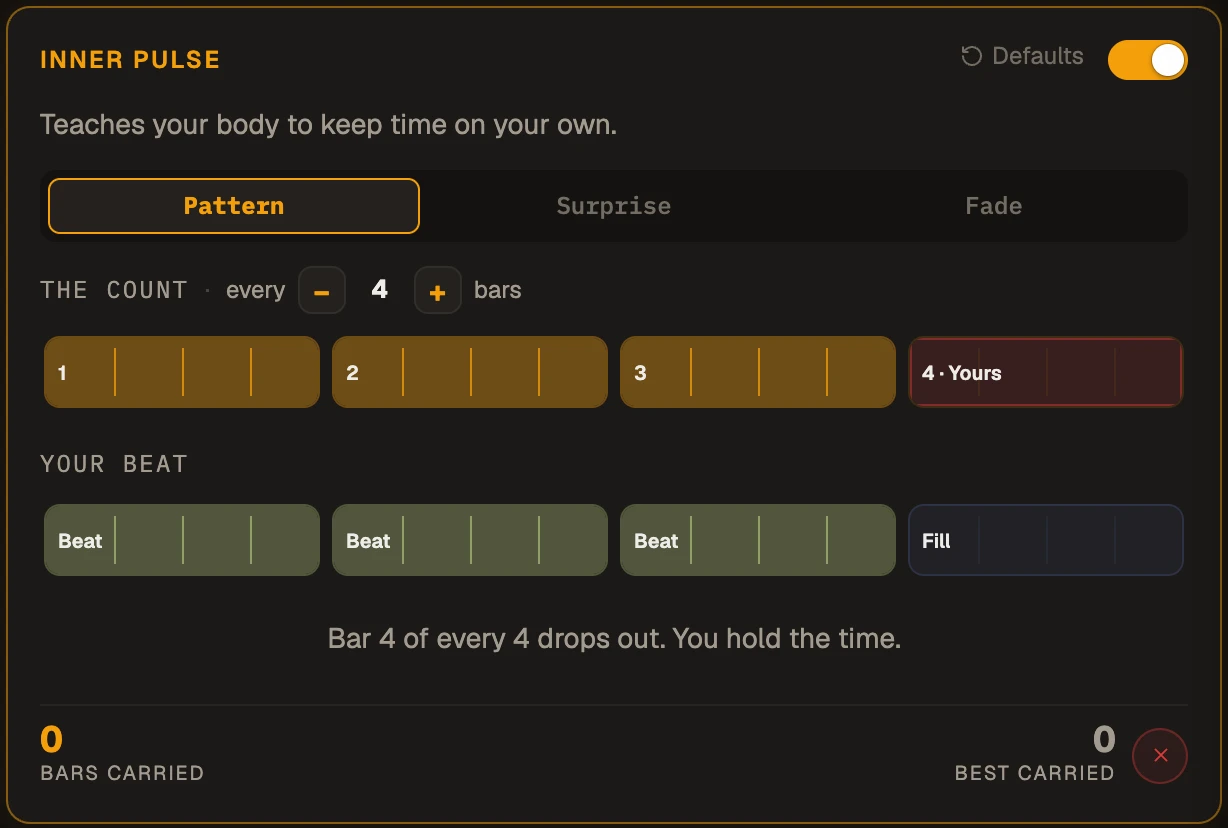
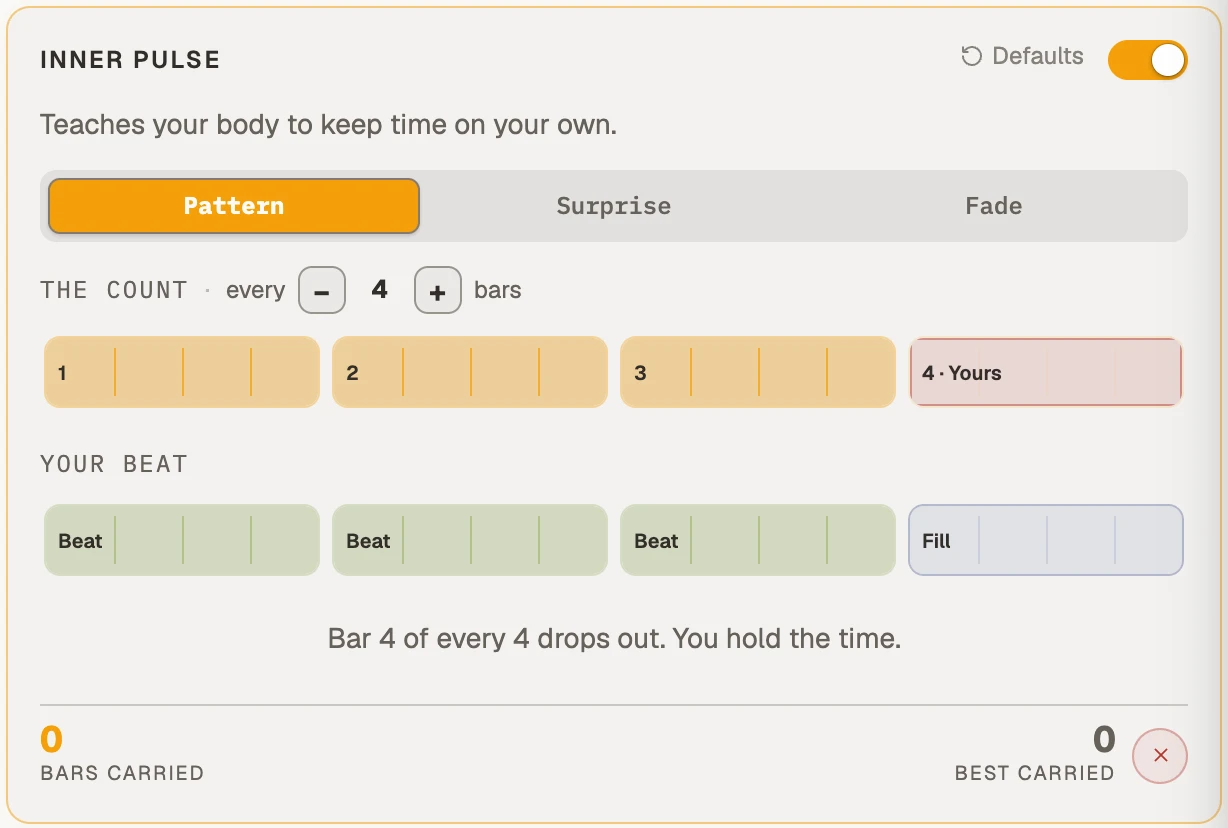
Inner Pulse now opens on Pattern, and Pattern is the mode a free account gets. It is the one other apps have taught people, so it is the one to be handed first: you choose where the silence falls, instead of waiting to be surprised. It opens on three bars with the fourth one yours, which is the drill the whole thing exists for.
The count is about time. Set it to every 4 bars, tap the cells that go quiet, and it repeats over whatever is playing: the fourth cell means the fourth bar, whoever is in it.
Your beat is about the music. Those cells are the bars your song is actually made of, by name, so silence the fill, move the fill, and the silence goes with it.
A bar goes quiet when either strip says so, so there is no mode to choose: mute in the row you mean, and tap single beats inside a cell when a whole bar is more silence than you want.
A free account gets all of that. Surprise and Fade are Pro.
You choose where the silence falls
Loop part of a Shift sequence
August 26, 2026
ShiftInner PulseTempo Trainer
Shift can now play a few bars of a sequence instead of all of it. Press Loop, tap the bar you want to start on and the bar you want to end on, and the rest waits its turn. It is the same two taps Beats already uses, so neither tab teaches a habit the other contradicts.
Press Loop beside Play, then tap the first bar and the last. Tapping one bar twice loops that bar on its own.
The order you tap in is the order it plays, so tapping bar 4 and then bar 1 drills the turnaround: 4, 1, 4, 1, round the end of the sequence and back.
A bracket marks the loop down the left of the sequence, in its own lane, so the bars themselves stay exactly as busy as they were.
Pressing Loop again switches it off and KEEPS the range, so play the whole thing, drill the hard bars, play the whole thing again costs nothing. The small cross next to it is what throws the range away.
Setting a loop while the music runs does not jump: if you are already inside it the round simply gets shorter next time it comes round, and if you are outside it the loop starts on its own downbeat.
The count-in counts you into the loop, not into bar 1.
Inner Pulse narrows to the loop, so the pattern you draw is the pattern you hear, and any bars you had already silenced stay on the bars you set them on.
Loops are whole bars, so a bar still means a bar: the bar count and the Tempo Trainer carry on counting the way they always did, mixed meters included.
The loop is a place in the sequence rather than a hold on particular bars, so dragging a bar out of it leaves the loop where it is, playing whatever now sits there.
The click gets a snare
August 26, 2026
MetronomeShiftBeats
A real snare joins the click sounds, and it does not hit the same way twice. The beat is a full stroke, the quieter cells between beats are ghost notes, and an accent is a harder hit rather than a louder one.
Acoustic Snare is the eighth click sound: a real drum, recorded stroke by stroke, drawing a different take each time so a run of subdivisions never sounds like one sample repeating.
An accent is a hard stroke and every other hit is a ghost note, so the only thing standing out is the beat you marked yourself, and a bar of sixteenths sounds like time being played rather than a click being repeated.
It is pitched a little above the recording, so it sits clear of the same drum playing underneath it in Beats.
The Acoustic Cowbell is gentler now, with the glare taken out of its top end, while its accent keeps the brightness that made it an accent in the first place.
Every recorded click rings out the way the drum does, rather than being cut short to make room for the next one.
Recorded clicks load faster, hold a fraction of the memory they used to, and land more exactly on the beat: each take carried a few milliseconds of silence at its head, and that arrived as drift.
The app now warms up only the click sound you have chosen, so opening it on a phone connection fetches less before you can play.
Edits you can see
August 23, 2026
MetronomeShift
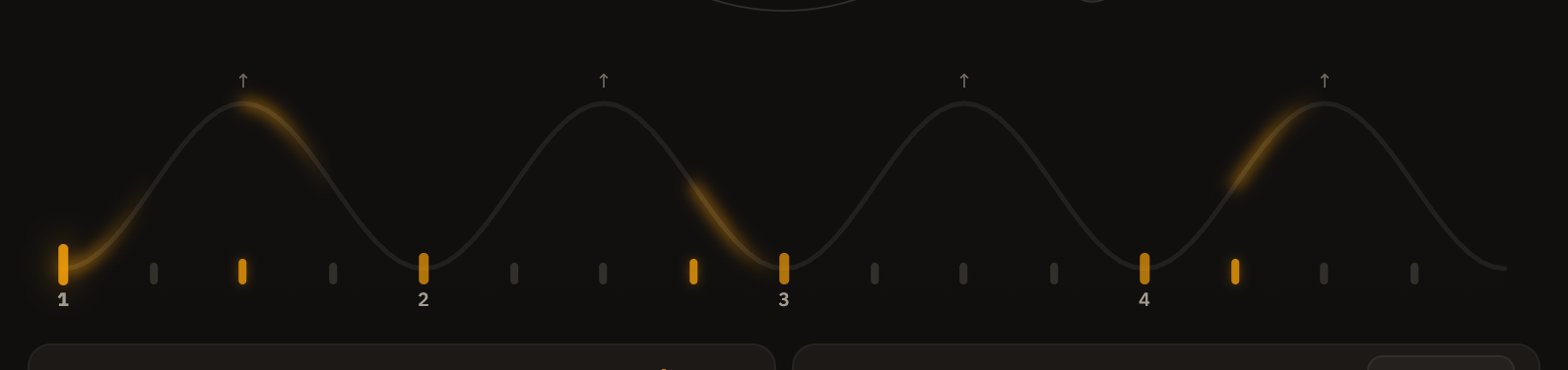
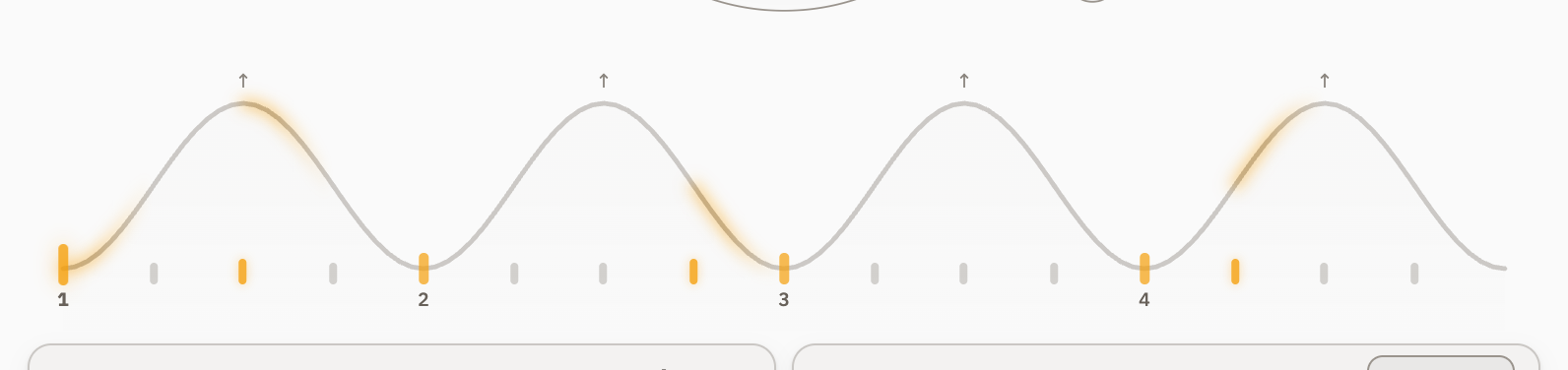
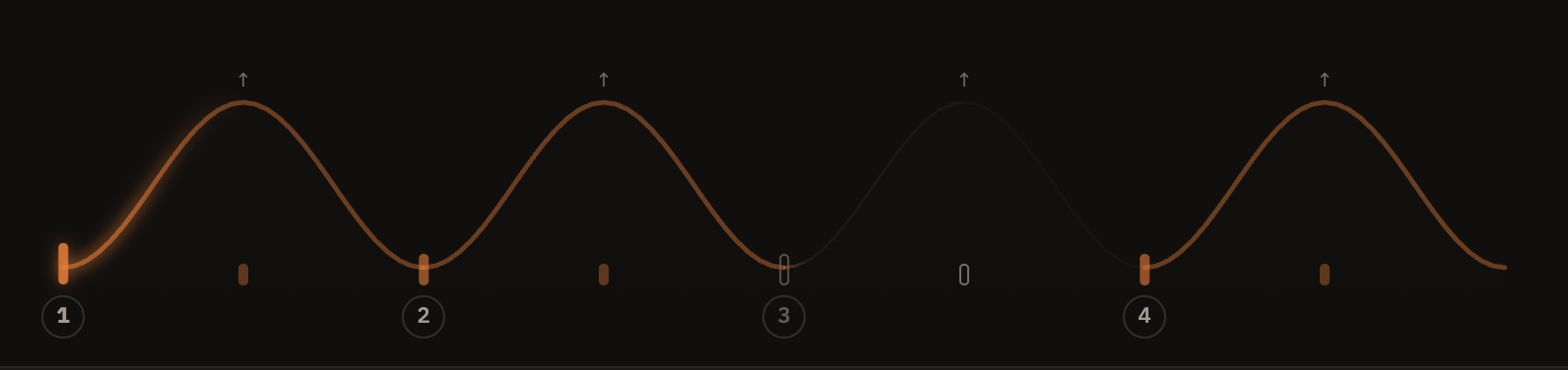
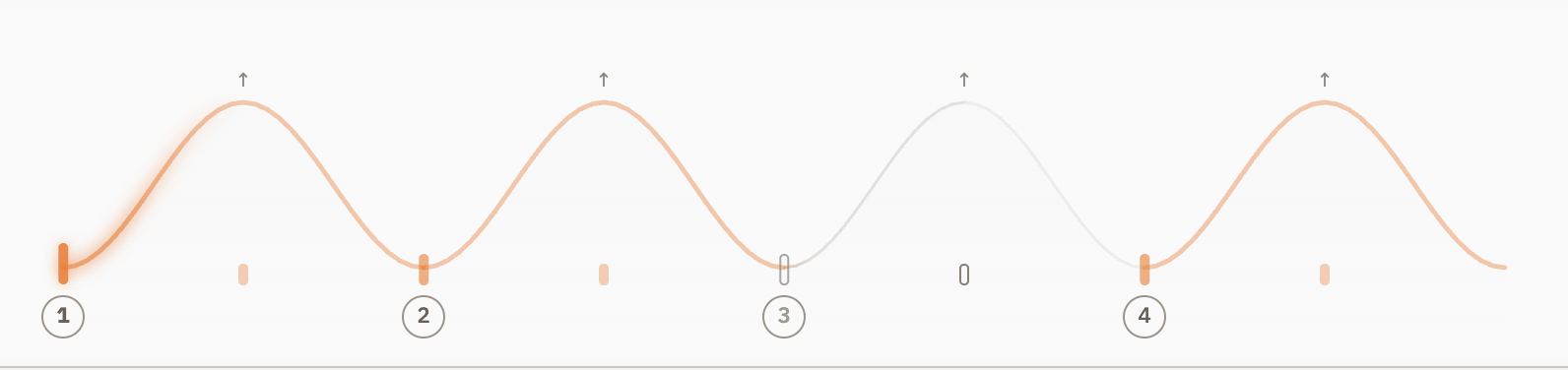
Editing now shows you what you did. The wave and the marks under it answer every tap and hold, the same way in the Metronome and in Shift.
Tap a beat or a subdivision to accent it and the wave lights up right where that hit falls.
Hold one to mute it and it fades out as you hold, so you can see where the gesture lands before you let go.
A rest is the same mark with the fill taken out, so the shape of a bar reads at a glance.
Accents carry more colour, in both views.
The tempo dial's trail is smoother, and the little dot that says another view is playing now pulses in time with what you hear.
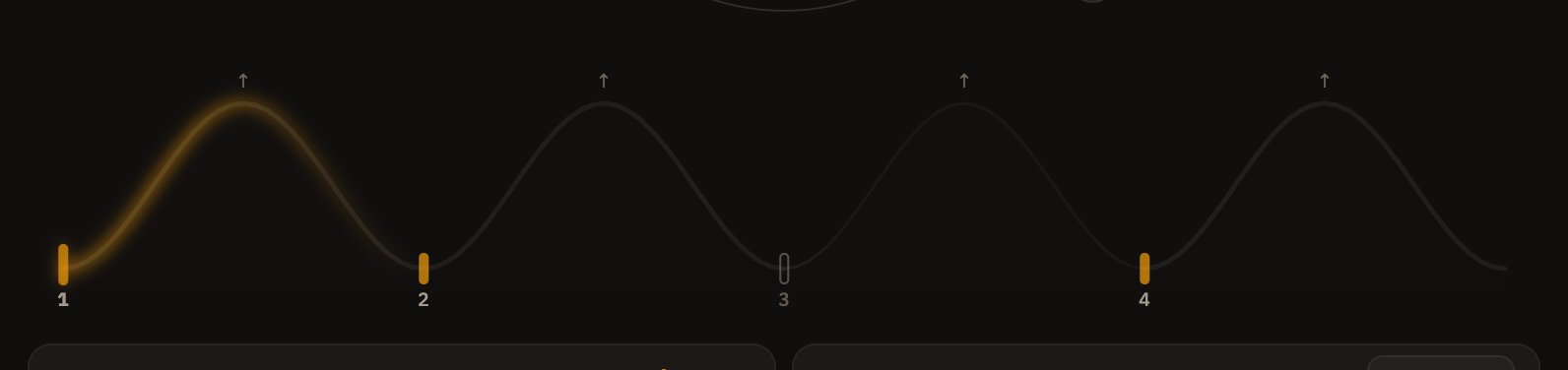
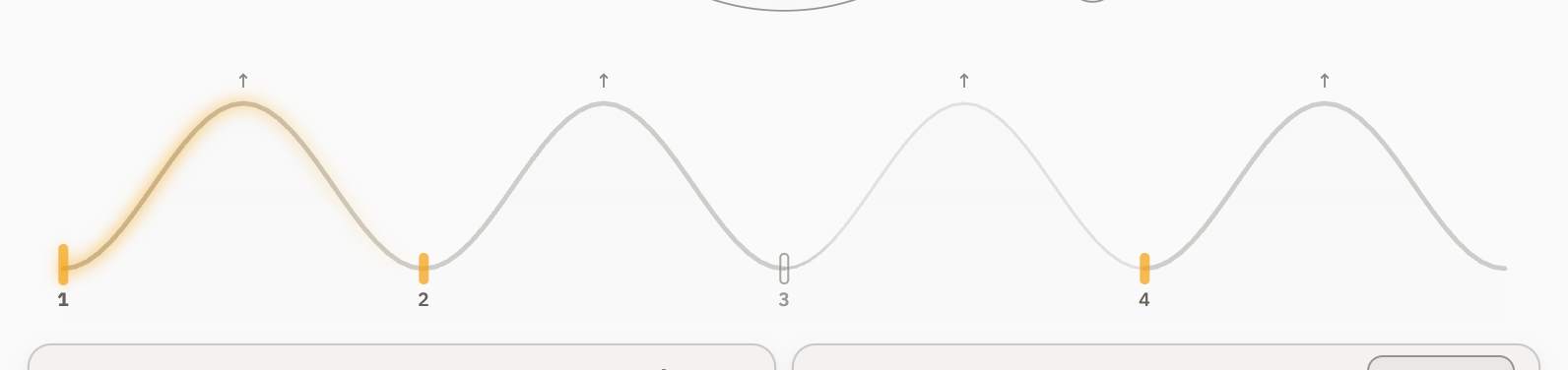
A rest is a hollow markAccents carry colourShift says it the same way
Compound meters get their real beat
August 22, 2026
MetronomeShiftBeatsTempo Trainer
A piece in 6/8 or 12/8 is counted in dotted quarters, and written that way too. The app counts them the same now, so the number on your page is the number you type.
Pick 6/8, 9/8 or 12/8 and the click lands once per beat, on the dotted note the meter is felt in.
A small mark beside the tempo switches the number to that beat, so a sheet that says dotted quarter equals 60 is typed as 60.
The choice follows you: the dial, the floating tempo pill, Beats, Shift and the Tempo Trainer all read the same unit, each for the meter in front of you.
Subdivisions are named for what they play in the meter you are in, and only the ones the beat can actually hold are offered.
Accents start on the meter's own groups: 6/8 on 1 and 4, 12/8 on 1, 4, 7 and 10.
The tempo counts the beat
One language for silence
August 22, 2026
MetronomeShiftInner Pulse
A rest you wrote and a beat Inner Pulse takes from you are different things, so they look different now, everywhere.
A rest you wrote dims its stretch of the wave and keeps the moving dot, because it is still part of what you are playing.
A beat Inner Pulse takes leaves you nothing to follow: no dot, no mark, and its own quieter colour instead of the red the app uses for deleting things.
Everywhere you paint those silences wears that same colour, so the panel, the rows and the wave all say one thing the same way.
Shift's wave carves out its rests like the Metronome's, and follows you to whichever bar you are editing.
Holding a beat to mute it moves the mark toward the rest it will become, so you can see where the gesture lands before it does.
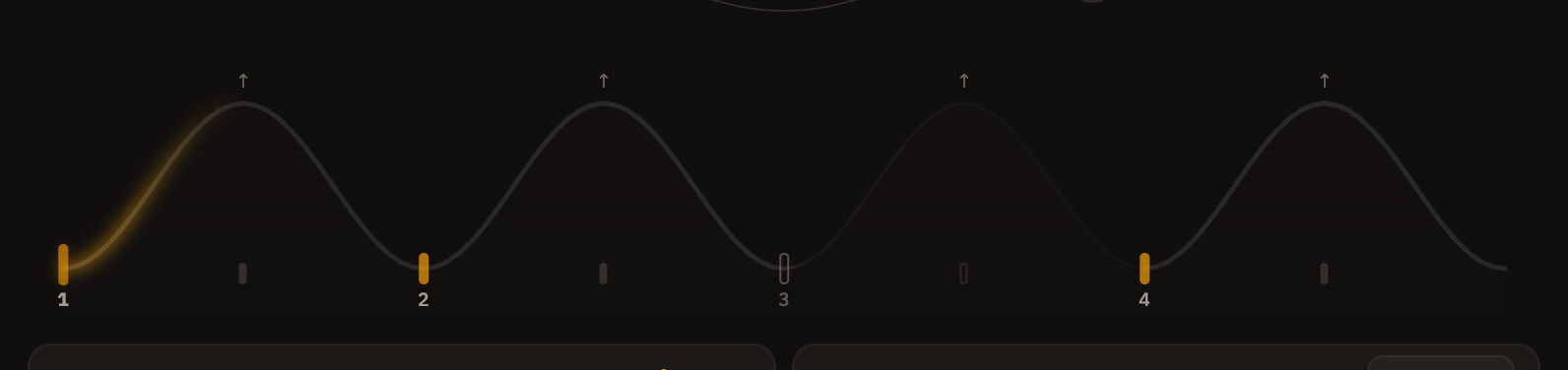
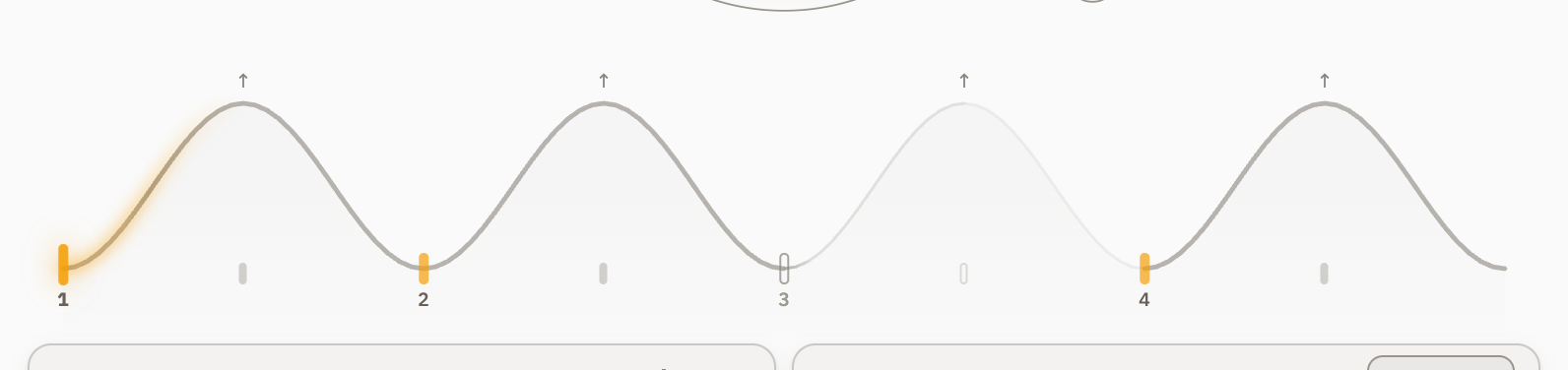
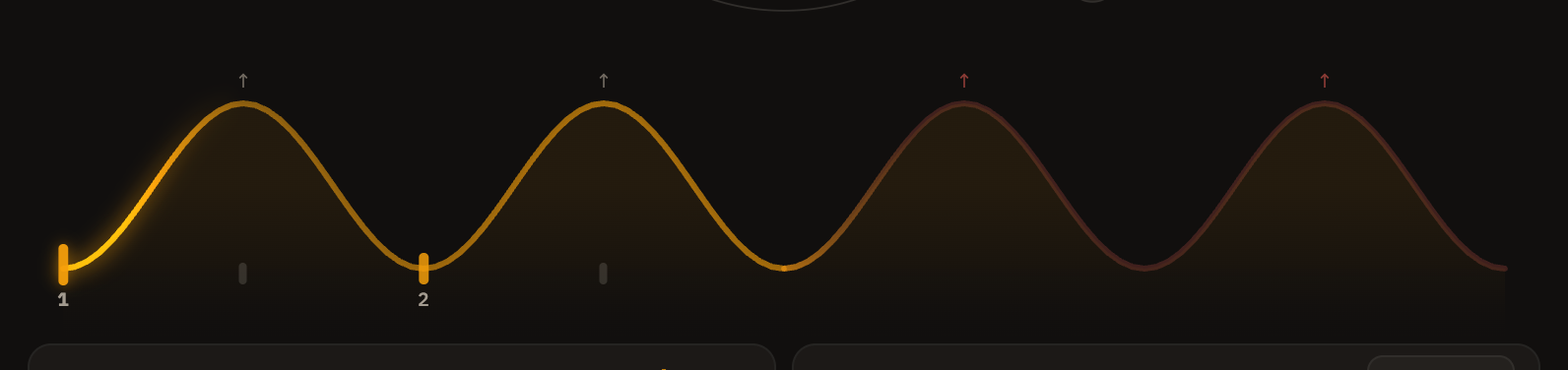
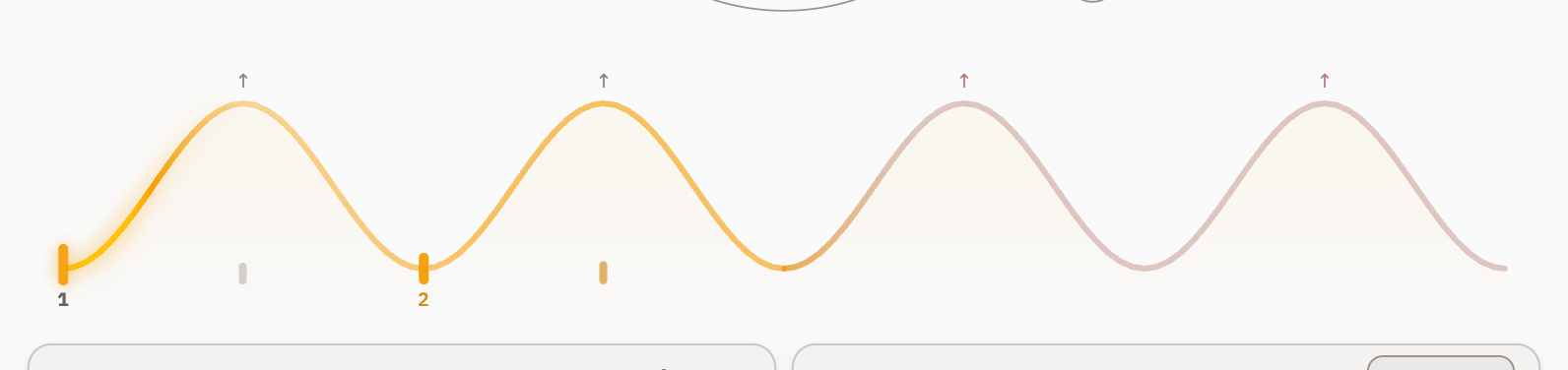
A rest you wroteA beat inner pulse takes
Renaming in place
August 22, 2026
BeatsShift
Renaming something now happens where the name is, in the same type it will be read in.
Renaming works the same everywhere it appears: Enter saves, Escape abandons, clicking away saves.
Beats keeps its bar count on screen after you stop, so you can see how long you just played.
Rehearsal room ready: the app works offline
August 20, 2026
AppBeatsMetronome
Practice spaces are where connections go to die, so the app stops depending on one. Visit once online and it opens, remembers who you are, and plays, even with no signal at all.
The app itself is now stored on your device after a visit, so it opens without a connection instead of showing a browser error.
Your plan is remembered on the device: Pro features no longer switch off when the connection drops.
Your preset library is remembered too: an offline open still has your presets and folders, and Beats and Shift arrive on their usual startup presets.
An unsaved beat now offers itself for restore even when the preset library cannot load.
When the connection returns mid-session, your plan and presets refresh in place, no reload needed.
Acoustic drum sounds you have played before are kept on your device and play offline; when they are missing, the app says so instead of playing silence, and the Electronic kit and the click always work.
When the connection returns, sound loading heals itself, no reload needed.
The app asks the browser to protect its stored sounds from cleanup, so a kit you warmed up at home stays ready in the rehearsal room.
Shift goes deep: every beat opens
August 18, 2026
Shift
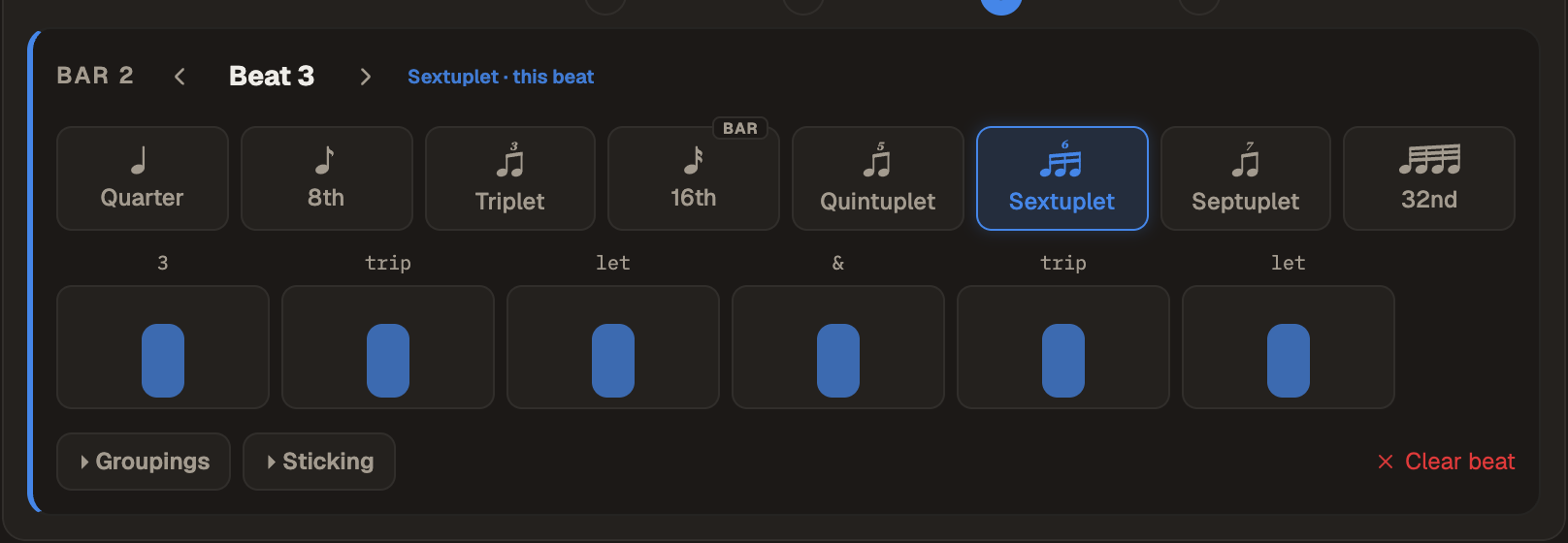
Every beat in a Shift bar now opens into its own card, where you shape exactly what it plays: the figure, the accents, the rests, and which hand plays what.
Tap the circled number under any beat to open its card; the arrow keys walk the open card through every beat, across bars.
Accent or rest every single hit inside a beat, on the card or directly on the bar row.
A shelf of curated figures per density offers the patterns worth practicing, not every mathematical option.
Each subdivision family wears its own colour across the rows and the wave, so density reads at a glance.
Counting speaks your language: western numbers, or konnakol, the South Indian counting syllables.
Show sticking on any beat, in the vocabulary of your instrument: hands, arrows, bowing or picking strokes.
Muting and accenting still mirror down to the simple beat level, so nothing you write gets lost.
A beat with its own subdivision
The wave joins the Shift sequence
August 18, 2026
Shift
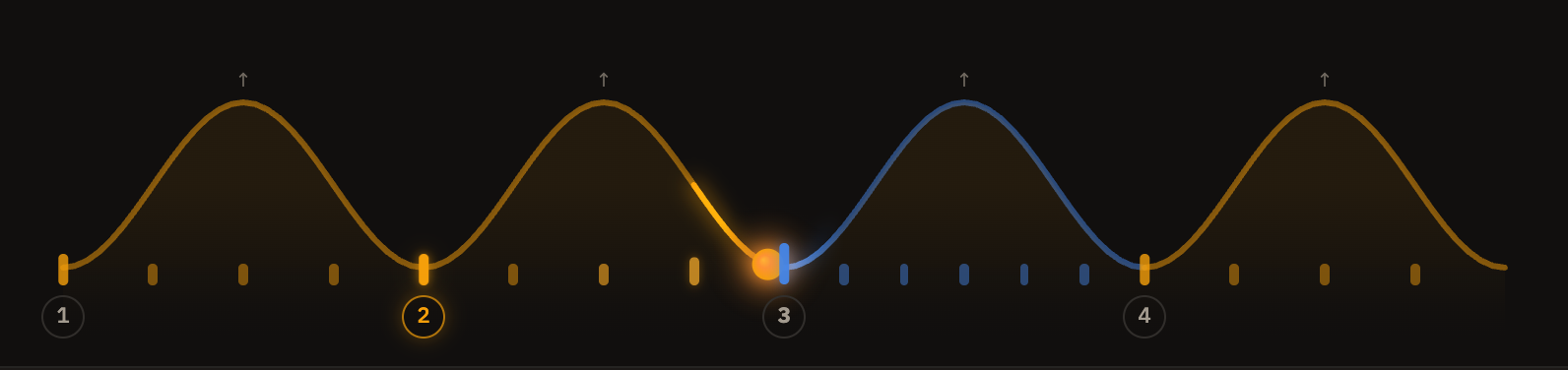
The wave above the sequence is no longer a spectator. While the music runs it always mirrors the playing bar, at each beat's own density and colour; stopped, it shows the bar you are working in. And it is an instrument: you edit right on it.
The playing bar draws itself on the wave live, lighting each hit as the playhead passes.
Tap a mark or a subdivision on the wave to accent it, hold to rest it; the circled number beneath opens that beat's card.
Undo and redo guard every arrangement edit, as buttons and as the usual keyboard shortcuts.
Swipe a bar out to the side to delete it; every delete answers with an Undo toast.
Auto-scroll is now opt-in: the wave carries the playhead, so the page only follows the music if you ask it to.
The wave plays the bar
The Metronome face, rebuilt
August 18, 2026
MetronomeInner Pulse
The wave is the instrument now. Beats are marks in the lattice with their number tucked beneath, everything on the face is directly editable, and one gesture pair works everywhere: tap accents, hold mutes.
Beats draw as lattice marks, the same shape family as the subdivisions, with the count beneath them.
Tap a beat or a subdivision to accent it, hold to rest it. A rested hit wakes on the first tap.
Muting a beat rests its subdivisions too; wake any of them back individually. A beat whose own downbeat rests shows it honestly.
The face rests in quiet grey and comes to colour when you play. Muting at rest answers in red that fades as the beat lets go.
The strike swells and glows with the tempo itself: crisp at 250, a long exhale at 30.
Changing time signature while playing now lands cleanly on the next downbeat.
Time signatures are named cards: Common, Waltz, Ballad, and Custom.
The live bar counter lives in the Time Signature panel, next to the signature it counts.
Beats counts every meter correctly
August 17, 2026
Beats
The grid header now takes its counting words from the same source as the Metronome and Shift, so every meter reads right.
Counting follows the cells in each beat, so 6/8 with a 16th grid reads 1 & 2 & instead of 1 e 2 e.
Dense grids anchor on their 16ths again: 32nds show e & a on the positions you count.
Subdivision chips name note values that stay true in every meter: 1/8T and 1/16T.
The beat button says which feel that beat is on before you open it.
A steadier app on the phone
August 9, 2026
App
A round of fixes from testing on real phones, from the lock screen to the smallest screens.
Pausing from the lock screen or your headphones now stops cleanly; nothing resumes behind your back.
The idle app no longer parks a stale card on the lock screen.
Tempo Trainer keeps its readout in step with what you hear.
The Beats transport fits a 320 pixel screen without crowding.
The strip is the arrangement
August 5, 2026
Beats
The separate Editor panel is gone. The strip under the transport is the arrangement itself: you play it, reorder it, tune each block and grow the song in place.
Lift a block and drag to reorder; drag it away to delete, with an Undo toast to take it back.
Each block opens its own card for name, repeats, colour and grid.
Add the next block right where the song ends.
Playing and arranging are separate modes, so a listening tap never rearranges your song.
A whole song in the strip
Loop any part of your beat
August 4, 2026
BeatsInner Pulse
Practice loops with real handles: bracket any span of the arrangement and the transport plays just that, while the rest of the song waits.
Drag the bracket handles on the ruler to loop any span of bars.
The loop is an anchor and a length, so editing the arrangement keeps it where you meant it.
The grid shows the loop edges in the same bracket language as the strip.
Inner Pulse follows the loop, so silent-bar practice lands on exactly the part you are drilling.
Bracket any span of bars
Inner Pulse explains itself
July 23, 2026
Inner Pulse
A comprehension and control pass across all three trainers. Every mode now says in plain words what its numbers do, and the controls became direct: drag the thing you want to change.
Surprise says it straight: this share of clicks drops out, you hold the time. The slider runs a green to red spectrum with zone names.
Get harder as I go climbs the difficulty smoothly while you play, with a draggable ceiling right on the slider.
Silent gaps are measured in beats, so the challenge feels the same at quarters and at 16ths.
Pattern gets a per-beat strip on every bar card, opening its editor below the grid.
Fade presets are one pill row, and the curve itself is the editor: drag its joints to shape the fade, the silence and the cycle length.
While Fade runs, a live readout names the phase you are in.
One home for every preset
July 22, 2026
MetronomeBeatsShift
Metronome, Beats and Shift now share a single preset browser, so learning it once is learning it everywhere.
Folders, search and recents work the same in every view.
Your own presets live in their own zone, first.
Save what you build, and suggest your best ones for the shared library.
Rows read quietly: difficulty is a label, not a shout.
Sounds load once and stay
July 21, 2026
BeatsApp
Drum samples now cache on your device after the first fetch, and the app only downloads the instruments the current beat actually uses.
Samples cache locally, so repeat visits start faster and use far less data.
A session fetches only the instruments its preset plays instead of the whole kit library.
The acoustic kit is re-encoded smaller with no audible loss.
Tempo Trainer arrives
June 28, 2026
Tempo Trainer
A trainer that moves the tempo for you while you play: up for speed, down for control, or both to build range.
Pick a direction: up, down, or up and down in waves.
Set how many bars between steps and how many BPM each step moves.
Your best streaks are remembered, and one tap clears them.
Engage it mid-play and it picks up from the bar you are in.
The Practice Timer keeps your session
June 28, 2026
App
A timer lives in the header across the whole app: set a target in minutes or bars, or let it count up freely while you practice.
Count down a target in minutes or bars, or count up in Free mode.
Choose what counts: real time, or only the time the music is actually playing.
The clock stays visible in every view while it runs.
Share a preset with a link
June 17, 2026
App
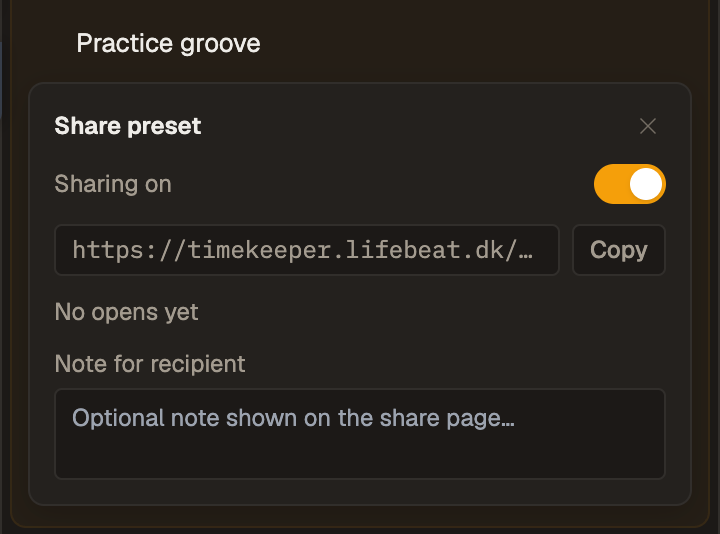
Any preset you save can travel: switch on sharing and it gets a link that opens your preset for anyone, account or not.
Every shared preset gets its own address you can send anywhere.
Opening the link loads the preset straight into the right view.
Turn sharing off any time and the link stops working.
A link anyone can open
A real drum kit moves in
June 16, 2026
Beats
Beats plays a real acoustic kit: a 1970s Ludwig, recorded at Lifebeat Studio.
Every instrument is a real recording with several velocity layers, so soft and hard hits are different sounds, not different volumes.
Repeated hits rotate through alternate takes, so a run of 16ths never sounds like a machine.
Flams and hi-hat chokes have their own recorded articulations.
Where this started
Spring 2026
AppMetronomeBeatsShift
Before any of the entries above there were months of prototyping: metronome after metronome, built and thrown away, and early versions of Beats and Shift full of bugs. One idea held them together. Build the best inner timing practice tool in the world.
The metronomes kept time, which turned out to be the easy half. They stuttered, they were poor on a phone, and they went one after another until the usability and the design were worth picking up.
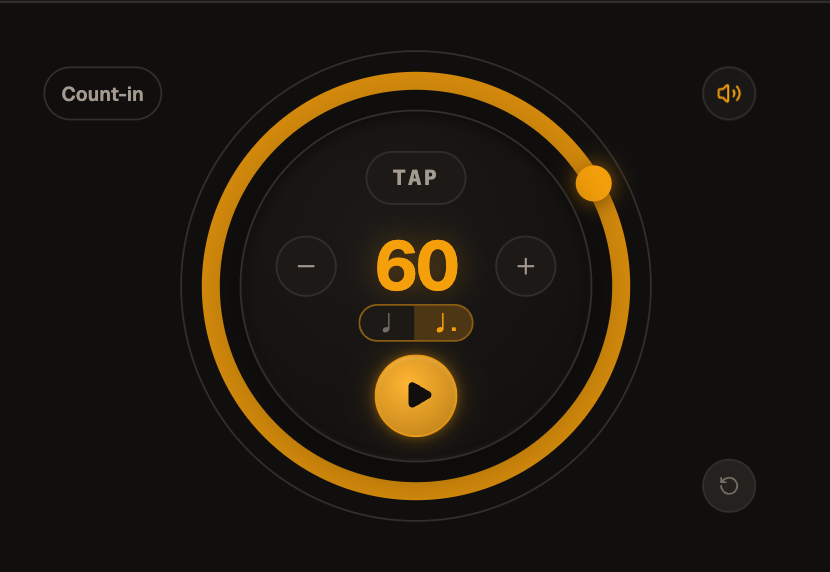
The tempo dial took more of those months than anything else. Setting the tempo, tapping it in, nudging it a step and starting the click all live in one control, and the way it answers a drag, a tap and a press was rebuilt over and over.
Beats had electronic sounds only, and bad ones, and it was rigid: one bar, looping. Shift was no steadier. Both were full of bugs, and both had the right idea.
Presets were buggy and all over the place for a long time. Signing in, saving and finding a preset again on the next device came early rather than last, and then had to be made worth trusting.
The DNA was there from the start. What brought it to where it is today was months of using the app and refining every button and every gesture.
The prototype on 27 March 2026, runningIts sequencer, four cells to a bar